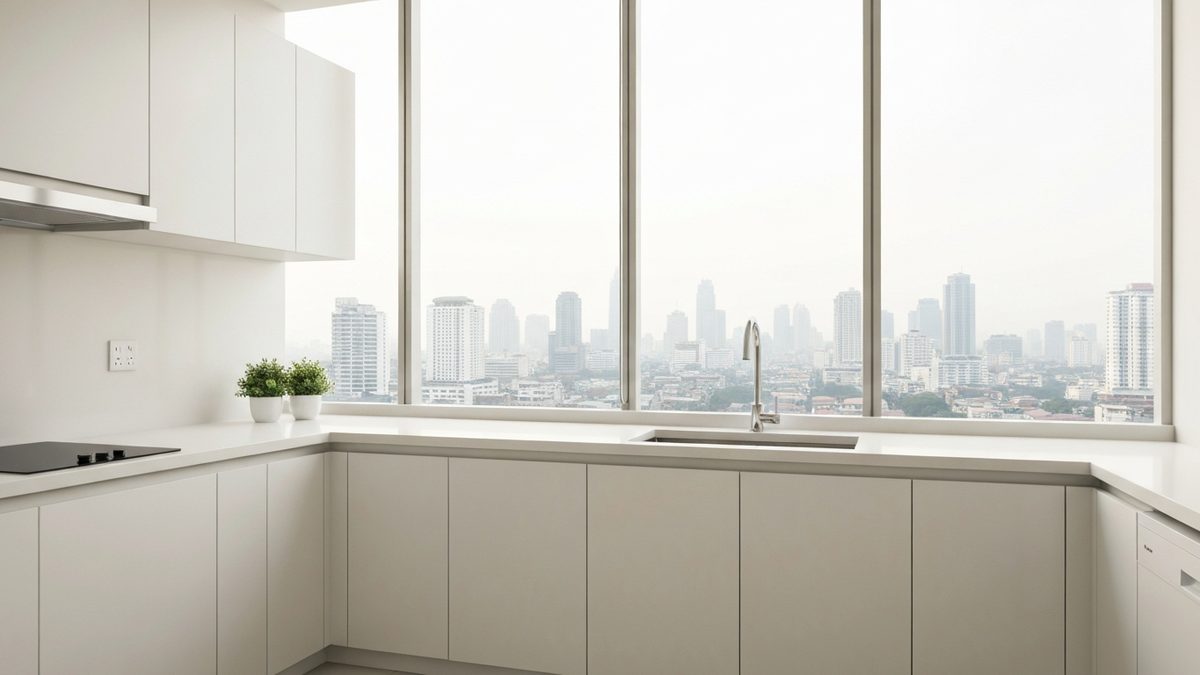
Every year from December to March, Bangkok's air thickens with PM2.5 (ฝุ่น PM2.5) — fine particles small enough to slip past the body's defences and lodge deep in the lungs. On the worst days the city tops global pollution rankings, with AQI readings above 150 turning the skyline hazy and prompting schools to keep children indoors. You can't fix the outdoor air, but you can make your home a clean-air refuge. This guide covers sealing your space, the right cleaning methods, aircon filter cleaning (ล้างแอร์), air-purifier sizing, and a sustainable cleaning rhythm to keep indoor PM2.5 low all dust season.
Why PM2.5 makes your home dustier and dirtier
PM2.5 particles are about 2.5 microns wide — roughly 30 times thinner than a human hair. They drift through gaps around windows and doors, settle invisibly on every surface, and get stirred back into the air whenever you walk across the room or wipe a shelf with a dry cloth. Unlike ordinary household dust, they don't fall and stay put; the finest fraction can hang in still air for hours.
During dust season the indoor particle count tracks the outdoor count unless you actively keep it out and clean it up. That is why ordinary 'tidy' homes still feel hazy and why people report sore throats, itchy eyes, and a dry cough indoors. The fix is a combination of three things working together: sealing to keep particles out, filtration to capture what gets in, and the right cleaning technique to remove what settles.
It's worth understanding where Bangkok's dust-season pollution comes from: a mix of vehicle exhaust, agricultural burning in surrounding provinces, and a weather pattern of cool, still air that traps everything close to the ground. Because the source is largely outside your control, defending the indoor envelope is the only lever you actually hold.
Seal the gaps first
Filtering air is pointless if dirty air pours in faster than you can clean it. Before anything else, reduce infiltration. Most Bangkok condos and townhouses have leaky window frames and door gaps that let PM2.5 stream in around the clock, and older buildings are worse.
Keep windows shut on high-AQI days, add foam or rubber weather-stripping to obvious gaps, and use a door draft stopper at the bottom of external doors. Run aircon on recirculate rather than fresh-air intake. A quick test: on a hazy day, hold a tissue near window and door edges — if it flutters, air is leaking and so is dust.
- Weather-strip window and door gaps: ฿100–400 per pack
- Door draft stopper: ฿150–400 each
- Keep windows closed and aircon on recirculate during high-AQI days
- Leave shoes and outerwear at the door to stop tracking particles inside
- Wipe pets down after walks — fur carries fine dust straight into the home
Clean the PM2.5 way: wet, not dry
- Wet-dust every surface with a damp microfibre cloth — dry dusting just relaunches particles into the air.
- Vacuum floors and rugs with a HEPA-filter vacuum so captured dust stays captured.
- Damp-mop hard floors after vacuuming to lift the finest settled particles.
- Wash or vacuum curtains and soft furnishings, which act like giant dust sponges.
- Wipe down high shelves, light fittings, and the tops of cabinets where fine dust accumulates unseen.
- Launder bedding weekly during dust season, since particles settle on pillows and sheets overnight.
- Clean in a logical order — high surfaces before floors — so dust you dislodge is captured on the final pass.
Aircon filters: your first line of defence
Your aircon recirculates room air constantly, so a dirty filter spreads dust rather than catching it. During PM2.5 season, clean or rinse the basic filters every two weeks. A clogged unit also runs less efficiently — meaning a higher electricity bill — and can grow mold on the coil that then blows into the room.
Beyond the user-cleanable mesh, a professional aircon service (ล้างแอร์) deep-cleans the coil, blower, and drainage that you can't reach — from ฿800 per unit. Booking this at the start of dust season means your aircon helps clear the air instead of recirculating grime all winter. Some households also fit a thin electrostatic or HEPA-type pre-filter behind the mesh to capture finer particles, though it must be cleaned more often to avoid choking airflow.
Air purifiers: sizing and placement
A true-HEPA air purifier is the most effective single device for indoor PM2.5. Match the unit's CADR rating to your room size — an undersized purifier in a large room barely moves the needle. As a rule, you want enough CADR to clean the room's air volume about five times an hour. For a typical bedroom (12–18 sqm) a mid-range HEPA unit (฿4,000–9,000) holds particle counts low; larger living rooms need a higher-CADR model or two units.
Place it away from walls and corners so air circulates freely, run it continuously on high-AQI days, and replace the filter on schedule — a clogged HEPA filter slowly stops working. Combined with sealing and wet-cleaning, a purifier transforms one or two rooms into a genuine clean-air zone. Many families designate the bedroom as the priority refuge, since that's where they spend eight unbroken hours every night.
Be wary of two common traps. First, 'HEPA-type' or 'HEPA-like' filters are not the same as true HEPA — only a genuine HEPA rating guarantees capture of the fine PM2.5 fraction. Second, ozone-generating 'ionic' purifiers may make the air smell fresh while doing little for particle counts and irritating sensitive lungs. Stick to a sealed true-HEPA unit with a verified CADR figure, and you'll know exactly what you're getting for your ฿4,000–9,000.
Build a dust-season cleaning rhythm
Consistency beats intensity. A light wet-dust and HEPA vacuum twice a week keeps indoor PM2.5 manageable far better than one big monthly blitz. Focus effort on the rooms where you spend the most time — usually the bedroom and living room — rather than spreading yourself thin across the whole home.
Many Bangkok households add a recurring service through the worst months. A standard clean runs ฿650–1,800 depending on size, and a one-off deep clean (฿1,499–3,499) with detailed dusting, curtain care, and surface wipe-down is a strong way to reset at the start of the season. A sensible plan is a deep-clean reset in early December, then a fortnightly standard clean through to March. Compare options on /pricing or browse more guides on /blog.
Protecting children, elderly, and sensitive lungs
PM2.5 hits the vulnerable hardest. Young children breathe faster relative to their body size, the elderly often have reduced lung capacity, and anyone with asthma, allergies, or heart conditions can see symptoms flare within hours of a high-AQI day. For these households, the clean-air refuge isn't a nice-to-have — it's a health measure.
Prioritise sealing and purifying the rooms these family members use most, keep an AQI app on your phone to plan outings around cleaner hours (often late evening when traffic eases), and have well-fitted N95 masks ready for the unavoidable trips outside. Indoors, the wet-cleaning routine matters even more, because settled particles are easily re-suspended by a crawling toddler or a shuffling walker.
When to bring in professional help
Call a service when dust has built up beyond a quick wipe — after a long stretch of high AQI, around high shelving and aircon vents, or when soft furnishings need a deeper clean than a home vacuum delivers. A professional deep clean tackles the accumulated fine dust that ordinary tidying leaves behind, and aircon servicing (ล้างแอร์) restores your unit's filtering power.
See the full menu on /services, or tell us your home size via /contact for a tailored dust-season quote.
Frequently Asked Questions
When is PM2.5 season worst in Bangkok?
Roughly December to March, with the heaviest haze often in January and February when cool, still air traps pollution over the city.
Why does wet-dusting matter for PM2.5?
Dry dusting and feather dusters just relaunch fine particles into the air. A damp microfibre cloth traps them, and a HEPA vacuum keeps captured dust from blowing back out.
How often should I clean my aircon filter during dust season?
Rinse the user-cleanable filters every two weeks, and book a professional coil clean (ล้างแอร์) from ฿800 at the start of the season so the unit filters rather than recirculates dust.
Do I need an air purifier and cleaning, or just one?
Both work together. Sealing and wet-cleaning remove settled dust; a HEPA purifier captures airborne particles. Used alone, each is far less effective than the combination.
How do I size an air purifier for my room?
Match the unit's CADR rating so it can clean the room's air volume about five times an hour. A mid-range HEPA unit (฿4,000–9,000) suits a 12–18 sqm bedroom; larger living rooms need a higher-CADR model or two units.
Don't let dust season fill your lungs and your home. Book a CLEANROVA deep clean plus aircon service (ล้างแอร์) via /contact and breathe easier from December through March.