You wipe the counter, you take out the trash, you store the sugar in a sealed jar — and the next morning there is still a thin black line marching across the worktop toward a crumb you never saw. Ants are the most common complaint we hear from Bangkok condo dwellers, and they are also the most misunderstood. Most people reach for a can of spray, kill the visible line, and feel victorious for two days. Then the trail returns, often thicker. The reason is biological: the ants you see are a tiny fraction of a colony whose queen and brood live somewhere you cannot reach, frequently inside a shared wall cavity you do not even own. This guide explains why the spray-and-pray approach fails, how to identify exactly what you are dealing with, how to prepare your unit so treatment actually holds, and when DIY ends and professional ant control (กำจัดมด) begins — with realistic Bangkok prices so there are no surprises.
Why Bangkok condos are ant magnets
Bangkok's heat and humidity keep ant colonies active all year — there is no winter die-off to give your kitchen a break. A colony that might go dormant for months in a temperate climate simply forages twelve months a year here, which is why a problem you knocked back in February reappears in May. High-rise condos make it worse, not better. Ants travel through shared wall cavities, plumbing risers, the expansion gaps in concrete, and the tiny voids around electrical conduit, so an infestation in the unit below or beside you quickly becomes your problem too. We regularly trace a trail in a 15th-floor kitchen back to a potted plant on a neighbour's balcony two units over.
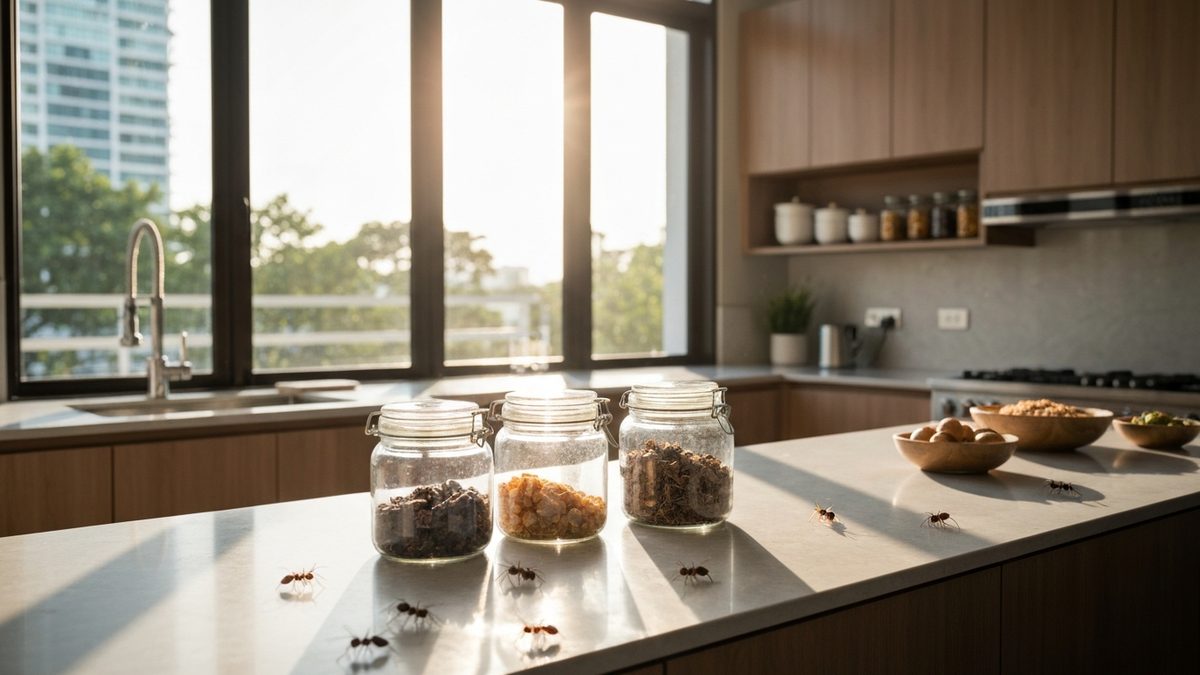
Kitchens are ground zero because they offer the three things every colony needs: water, warmth, and food. A single drop of syrup behind the toaster, a pet bowl left out overnight, or condensation pooling under the dish rack is enough to establish a foraging route. Once a scout finds a reliable source, it lays a chemical pheromone trail that recruits hundreds of workers within hours — which is why a kitchen can look clear at midnight and host a busy highway by 6am.
Newer condos are not immune. Developers seal units well, but the same sealed envelope that keeps your aircon in also traps the warmth and moisture ants love, and the service risers that carry water and waste between floors act as ready-made ant motorways. Older buildings around areas like Phra Khanong, On Nut, and the inner Sukhumvit sois tend to have more porous concrete and worn silicone, giving ants even more ways in.
Identify the species before you do anything
Treatment depends entirely on which ant you have, so identification is step one and the step most people skip. Use the wrong method and you can genuinely make the infestation worse. The three you will almost certainly meet in a Bangkok kitchen are:
- Pharaoh ants — tiny, pale yellow-brown, roughly 2mm, the classic kitchen invader. Critically, spraying them triggers the colony to 'bud' or split into multiple new sub-nests, so a single trail can become five. These must be baited, never sprayed — this is the most important identification you can make.
- Ghost ants — pale, almost translucent legs and abdomen with a dark head, very small and fast. They love sweet, moist environments and nest in wall voids, potted plants on the balcony, and the damp gap behind the kitchen sink.
- Big-headed ants and black house ants — larger and darker, often trailing in from the corridor, the lift lobby, or the balcony. They are more tolerant of spray but still resolve far more reliably with bait carried back to the nest.
- Carpenter ants — larger still, occasionally seen where there is damp or decaying wood (built-in cabinetry, water-damaged door frames). Less common in condos but worth flagging because they signal a moisture problem worth investigating.
Find the entry point and the nest
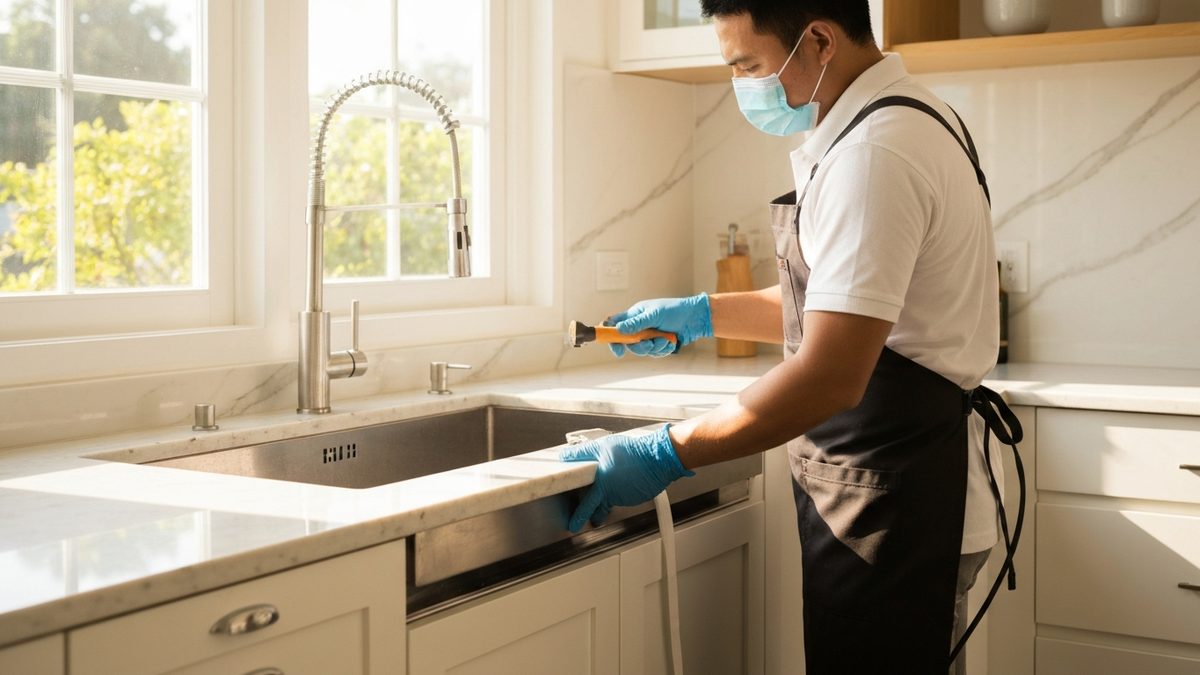
Follow the trail in both directions. Where the ants disappear is far more useful than where they are feeding. Common entry and nesting spots in Bangkok condos include the gap under the kitchen sink where the drainpipe passes through the cabinet, the silicone seal behind the backsplash, the channel where the countertop meets the wall, the cracks around window or balcony door frames, and the perimeter of recessed ceiling lights where wiring penetrates the slab.
Do not destroy the trail while you are investigating. The pheromone line is your map. Once you understand the route, you can place treatment exactly where it will be picked up and carried back to the colony. A common mistake is to wipe everything down in frustration and then call us — without an active trail, even a technician has to wait for the ants to re-establish before baiting effectively.
- Wait until evening when foraging peaks, then watch a single line for two minutes without disturbing it.
- Note the exact crack, gap, or seam where ants enter and exit — mark it lightly with a pencil if helpful.
- Check the balcony, potted plants, and the shared wall with neighbours — colonies often nest outside the kitchen and commute in along a fixed route.
- Photograph a few ants on a plain white surface (a sheet of paper works) to confirm the species, or send the photo to us via /contact before booking so we arrive with the right bait.
- Note whether the ants are after something sweet (sugar, fruit) or greasy/protein (meat, pet food) — their preference shifts seasonally and tells us which bait formulation to bring.
Bait versus spray: why bait almost always wins
Spray is satisfying and almost useless. It kills the workers you can see — perhaps five percent of the colony — while the queen keeps laying eggs in a wall void you cannot reach. A queen can produce hundreds of eggs, so the trail you 'won' against is replaced within days. With pharaoh ants, spray does worse than nothing: the survivors scatter and the colony buds into several smaller nests, multiplying your problem across the unit.
Gel and liquid baits work the opposite way and exploit the ants' own behaviour. Workers carry the slow-acting bait back to the nest and feed it to the queen and brood through a process called trophallaxis, collapsing the colony from the inside over one to two weeks. The 'slow' part is the point — a bait that killed instantly would never reach the queen. It feels less dramatic than watching ants drop, but it is the only approach that ends the infestation rather than thinning the trail.
A worked example: a Thonglor client had a pharaoh-ant trail along the backsplash. They had sprayed it weekly for a month, and by the time we arrived there were four separate trails instead of one — classic budding. We placed a sweet gel bait at each entry point, asked them to stop cleaning the trails for ten days, and the entire system collapsed by day twelve. The total cost was less than they had spent on spray cans.
- Use bait, not spray, for any small kitchen ant — especially pharaoh and ghost ants.
- Place bait directly on the active trail, near the entry point, not where you think the ants 'should' be.
- Resist the urge to clean the trail or kill workers for the first week — they need to keep visiting the bait.
- Never combine bait and spray in the same area; the spray repels ants away from the bait and ruins it.
- Be patient — a thinning trail over a week is success, not failure. A trail that vanishes in an hour usually means you sprayed and the problem will return.
Prepare your kitchen before treatment day
Whether you bait yourself or book a professional, a little preparation makes the difference between a treatment that holds and one that fizzles. The goal is simple: make the bait the most attractive thing in the kitchen by removing every competing food source, while leaving the trail intact so the ants keep moving.
Two or three days before treatment, do the following. Clear competing food — sealed containers for everything, no open sugar or fruit on the counter. Wipe down all surfaces except the active trail and the immediate entry points. Empty and clean under the bin. Pull appliances out enough that the technician can reach the gaps behind them. Crucially, do not spray anything in the days before a bait treatment — residual repellent can keep ants away from the bait for days and waste the visit.
- Move open food, fruit bowls, and pet food into sealed containers or the fridge.
- Clean all surfaces except the active ant trail and entry points — leave those untouched.
- Empty the bin and clean any residue underneath the liner.
- Pull the fridge, oven, and microwave forward a few centimetres so harbourage gaps are accessible.
- Stop all spraying at least 48 hours before a bait treatment so repellent does not interfere.
Sanitation: the part you cannot skip
No treatment holds if the kitchen keeps offering an easier meal than the bait. Sanitation is not glamorous, but it is what makes results permanent rather than a temporary truce.
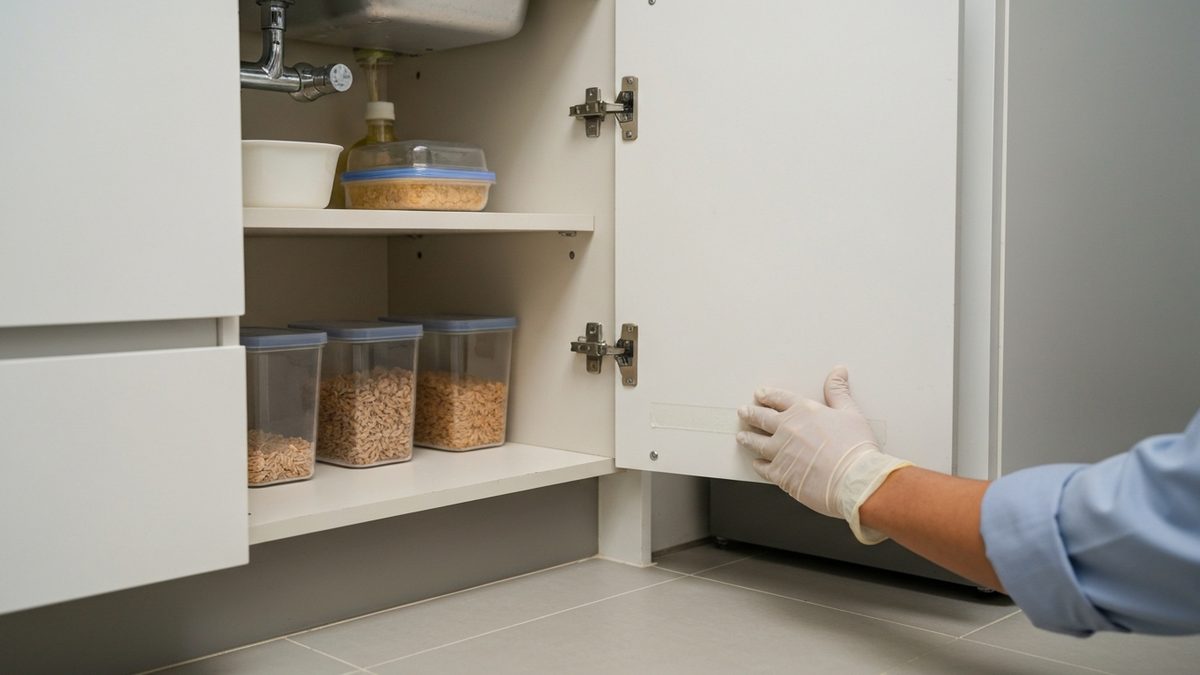
Store sugar, honey, cereal, and pet food in sealed containers — clip-lid or screw-top, not loosely folded bags, which ants walk straight into. Wipe counters with a vinegar-water solution at night, which also erases pheromone trails and removes the chemical map future scouts would follow. Empty the bin nightly, rinse recycling before it sits, and check behind and under appliances where grease and crumbs collect unseen. Fix any slow drip under the sink — in Bangkok's humidity a reliable water source alone can sustain a colony even when food is scarce, so a single leaking trap can undo all your other efforts.
Pay particular attention to the things people forget: the crumb tray under the toaster, the gasket of the kettle base, the overflow channel of the dish rack, and the seam where the hob meets the worktop. These low-traffic spots are exactly where a colony quietly refuels.
When to call a professional, and what it costs
DIY bait handles a single, simple trail of an easy-to-identify species. Call a professional when the infestation recurs after baiting, when you see multiple trails or winged ants (a sign of a maturing colony preparing to spread), when ants are clearly coming from a shared wall and your neighbours are also affected, when you suspect pharaoh ants and want to avoid making things worse, or when you simply want it solved quickly and correctly the first time.
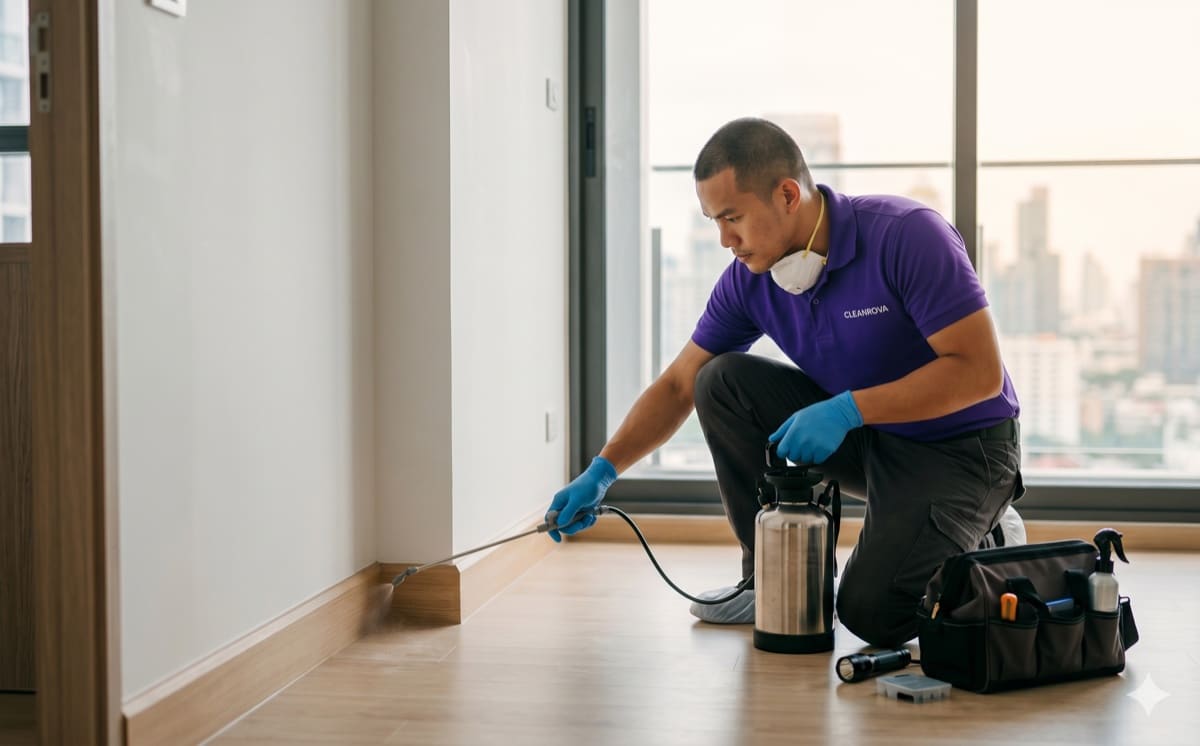
Realistic Bangkok pricing for ant control (กำจัดมด): a one-time targeted ant treatment for a condo kitchen runs roughly ฿800–1,500 depending on unit size and severity. A typical one-bedroom unit with a single trail sits near the lower end; a larger two- or three-bedroom unit, a multi-room infestation, or a case needing wall-void injection sits at the upper end or slightly above, around ฿1,500–2,500. For recurring problems — common in older buildings and lower floors near rubbish rooms — a quarterly contract typically lands around ฿2,500–4,500 per year, which usually works out cheaper than repeated one-time visits and includes follow-up inspections to confirm the colony has not rebuilt. See our /pricing page for current packages, compare what is included on /services, or browse more pest guides on /blog.
Coordinating with your building
If ants are travelling through shared walls or risers, treating only your unit is like bailing a boat with a hole still in it. Let your building's juristic office (the niti bukkhon) know — a colony in a wall cavity often affects a whole stack of units, and a coordinated treatment of common areas and the affected stack is far more effective and durable than each owner fighting alone.
A good pest-control service can document the entry points and the likely source so you have concrete evidence to bring to building management, rather than a vague complaint they can wave away. In our experience, presenting the juristic office with photos of trails and a technician's note of where the colony is feeding makes them far more willing to authorise common-area treatment. If several units in your stack report ants at once, that is your strongest argument for a building-funded solution — point your neighbours to /contact so everyone reports it together.
Frequently Asked Questions
Why do the ants come back a few days after I spray?
Because spray only kills visible workers while the queen keeps producing more in a hidden nest you cannot reach. The workers you see are roughly five percent of the colony. With pharaoh ants, spray is even worse — it can split the colony into several sub-nests through a process called budding. Bait is the only common method that reaches and eliminates the queen, which is what actually ends the infestation.
Are kitchen ants in Bangkok dangerous?
They are not venomous and rarely bite, but they can carry bacteria across food preparation surfaces, which matters in a kitchen. Pharaoh ants in particular are documented carriers of contaminants, so it is worth eliminating them properly rather than tolerating the trail. They are a hygiene concern more than a direct health threat, but a real one in any home where food is prepared.
How long does professional ant treatment take to work?
You will usually see the trail thin within a few days and the colony collapse within one to two weeks as the bait spreads to the queen and brood. This is normal and expected — a treatment that appears to work instantly has probably just repelled the ants temporarily. We schedule a follow-up to confirm the nest is gone and to seal entry points so the next colony cannot reuse the same route.
Will the treatment be safe around food and pets?
Yes. Professional ant baits are placed in targeted spots — cracks, gaps, and the backs of cabinets — away from open food and out of reach of pets and children, and they are formulated for indoor residential use. We will tell you exactly where bait is placed, what to avoid for the first few days, and where it is safe to clean so you do not accidentally remove it.
Can I just keep my kitchen clean and avoid ants altogether?
Excellent sanitation dramatically reduces your risk and is essential, but in a Bangkok condo it cannot guarantee zero ants because the pressure comes through shared walls, risers, and drains from outside your unit. Think of cleanliness as making your kitchen unattractive enough that scouts move on — combined with sealed entry points and, where needed, a recurring prevention plan, it keeps most kitchens trail-free.
Still seeing the trail after wiping it down? Book a professional ant assessment with CLEANROVA — we identify the species, find the nest, and bait it properly so it does not come back. Get in touch via /contact or check packages on /pricing.